
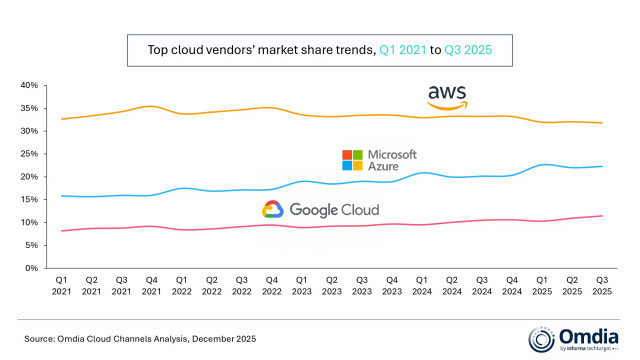
In Q3 2025, AWS, Microsoft Azure, and Google Cloud maintained their market rankings from the previous quarter, collectively accounting for 66% of global cloud infrastructure spending. Together, the three hyperscalers delivered 29% year-on-year growth.
AWS’s growth reaccelerated to 20% year on year quartering Q3 2025, marking its strongest performance since 2022. Microsoft Azure and Google Cloud also maintained strong momentum, each delivering year-on-year growth of more than 35%. As enterprise demand for AI continues to materialize, growth in the cloud market is shifting from early-stage experimentation and pilot projects toward the scaled deployment of enterprise-grade AI applications. Backlog levels among leading cloud providers continued to rise, with AWS, Microsoft, and Google Cloud all reporting further increases in Q3 order backlogs, reinforcing the market’s underlying resilience and healthy demand environment.
Hyperscalers’ AI strategies are evolving from a primary focus on incremental model performance toward more platform-driven and production-ready approaches. Enterprises are no longer evaluating AI platforms solely on model capabilities, but increasingly on their support for multi-model strategies and agent-based applications.
This shift is accelerating hyperscalers’ move toward platform-level AI capabilities. AWS, Microsoft Azure, and Google Cloud are integrating proprietary foundation models with a growing range of third-party and open-weight models, leveraging managed AI platforms and services such as Amazon Bedrock, Azure AI Foundry, and Vertex AI’s Model Garden to expand support for multi-model adoption.
“Collaboration across the ecosystem remains critical,” said Rachel Brindley, Senior Director at Omdia (https://cts.businesswire.com/ct/CT?id=smartlink&url=https%3A%2F%2Fomdia.tech.informa.com%2Fauthors%2Frachel-brindley&esheet=54382102&newsitemid=20251222110841&lan=en-US&anchor=Rachel+Brindley%2C+Senior+Director+at+Omdia&index=1&md5=00e8e6b6a67dc6056ad5d28a025ca698). “Multi-model support is increasingly viewed as a production requirement rather than a feature, as enterprises seek resilience, cost control, and deployment flexibility across generative AI workloads.”
Meanwhile, hyperscalers are stepping up investment in agent build-and-run capabilities, as real-world deployment continues to prove more complex than early experimentation suggested. “Many enterprises still lack standardized building blocks that can support business continuity, customer experience, and compliance at the same time, which is slowing the real-world deployment of AI agents,” said Yi Zhang, Senior Analyst at Omdia (https://cts.businesswire.com/ct/CT?id=smartlink&url=https%3A%2F%2Fomdia.tech.informa.com%2Fauthors%2Fyi-zhang&esheet=54382102&newsitemid=20251222110841&lan=en-US&anchor=Yi+Zhang%2C+Senior+Analyst+at+Omdia&index=2&md5=b634a63e10b3805918c2858bf7c4b19e). “This is where hyperscalers are increasingly stepping in, using platform-led approaches to make it easier for enterprises to build and run agents in production environments.”
Recent launches such as AWS AgentCore and Microsoft’s Agent Framework reflect this direction, providing standardized foundational capabilities that help enterprises more efficiently build, deploy, and operate AI agents in production settings.
Amazon Web Services (AWS) led the global cloud infrastructure market with a 32% share and 20% year-on-year revenue growth. This performance was supported by easing compute supply constraints, alongside incremental demand driven by its partnership with Anthropic. AWS reported a total backlog of $200 billion by the end of Q3, underscoring sustained demand. Amazon Bedrock continues to evolve rapidly, expanding both model choice and platform capabilities, including support for Claude 4.5, 18 managed open-weight models, and enhanced Guardrails and Data Automation features. At AWS re:Invent 2025, AWS also introduced the Nova 2 model family, Nova Act, and Nova Forge, strengthening its end-to-end enterprise AI stack from models to agents and automation. In addition, AWS expanded its regional footprint with the launch of the AWS Asia Pacific (New Zealand) Region in September, adding three availability zones to support local data residency and low-latency workloads.
Microsoft Azure remained the world’s second-largest cloud provider in Q3 2025, holding a 22% market share and delivering robust 40% year-on-year revenue growth. In October, Microsoft renewed its partnership with OpenAI, further anchoring OpenAI’s AI development and deployment on Azure. Azure AI Foundry continued to broaden its model ecosystem, supporting multiple frontier foundation models, including Claude Opus 4.5, Claude Sonnet 4.5, and Haiku 4.5. The platform now serves more than 80,000 customers and provides access to over 11,000 models. In October, Microsoft also introduced the Microsoft Agent Framework, enabling enterprises to build and orchestrate multi-agent systems. Customers such as KPMG are already applying the framework to enhance audit processes, with these production-grade AI deployments contributing to Azure’s overall growth momentum. In parallel, Microsoft continued to invest in regional infrastructure, announcing plans in November to expand its Azure cloud region in Malaysia and to launch a new Azure datacenter region in India in 2026.
Google Cloud remained the world’s third-largest cloud services provider in Q3 2025, delivering strong 36% year-on-year growth and increasing its market share to 11%. Growth was primarily driven by enterprise AI offerings, with quarterly revenue from this segment reaching several billion dollars. As of September 30, Google Cloud reported a backlog of $157.7 billion, up sharply from $108.2 billion in Q2, underscoring strengthening demand visibility. On the platform side, Vertex AI’s Model Garden continued to expand its large-scale AI model portfolio, adding new models such as multimodal variants from the Gemini 2.5 series, Kimi K2 Thinking, and DeepSeek-V3.2. In October 2025, Google Cloud also launched Gemini Enterprise, an AI platform designed for enterprise customers that integrates the Gemini model family with enterprise-grade AI agents, no-code development tools, and security and governance capabilities.
Omdia defines cloud infrastructure services (https://cts.businesswire.com/ct/CT?id=smartlink&url=https%3A%2F%2Fwww.canalys.com%2Fanalysis%2Fcloud-channels&esheet=54382102&newsitemid=20251222110841&lan=en-US&anchor=Omdia+defines+cloud+infrastructure+services&index=3&md5=037714fa1e5a3e9248d3201182381ccd) as the sum of bare metal as a service (BMaaS), infrastructure-as-a-service (IaaS), platform-as-a-service (PaaS) and container-as-a-service (CaaS) and serverless that are hosted by third-party providers and made available to users via the Internet.
ABOUT OMDIA
Omdia, part of Informa TechTarget, Inc. (Nasdaq: TTGT), is a technology research and advisory group. Our deep knowledge of tech markets grounded in real conversations with industry leaders and hundreds of thousands of data points, make our market intelligence our clients’ strategic advantage. From R&D to ROI, we identify the greatest opportunities and move the industry forward.
View source version on businesswire.com: https://www.businesswire.com/news/home/20251222110841/en/
언론연락처: Omdia Fasiha Khan Eric Thoo
이 뉴스는 기업·기관·단체가 뉴스와이어를 통해 배포한 보도자료입니다.
ⓒ BIZ PAPER & bizpaper.co.kr 무단전재-재배포금지
전체댓글 0
실시간뉴스


추천뉴스


정치
more +
![‘솔로 데뷔 D-DAY’ NCT 마크, “‘The Firstfruit’는 제 인생을 바탕으로 만든 앨범” [일문일답]](/data/news/202504/news_1744347206.1.jpg)
포토뉴스
more +-

한-일 인디밴드를 연결하는 ‘Reciprocity 2026’ 올해도 개최
한일 인디 음악 교류 프로젝트 ‘Reciprocity 2026’가 올해도 개최된다.‘Reciprocity’는 한국과 일본의 인디 밴드들이 한 무대에서 만나 교류하는 시리즈 공연으로, 양국 음악 씬의 새로운 연결을 만들어가는 것을 목표로 한다.하루짜리 페스티벌의 형식으로 개최됐던 ‘Reciprocity 2025’와는 달리 이번 ‘Reciprocity 202... -

도서출판 미래지식 ‘일론 머스크 X, 속도의 제국’ 출간
도서출판 미래지식은 ‘일론 머스크 X, 속도의 제국’을 출간했다고 27일 밝혔다.인류 역사상 가장 거대한 ‘속도의 제국’은 어떻게 만들어지는가?이 책은 한 인물의 성공과 일생을 다루는 전기가 아니다. 머스크의 손에서 펼쳐지는 미래 산업을 관통하는 전략서다. ‘일론 머스크 X, 속도의 제국’은 테슬라, 스페이스X, xAI... -

일리윤 ‘몬치치’ 협업 기획세트 출시
아모레퍼시픽 더마 브랜드 일리윤이 글로벌 캐릭터 ‘몬치치’와 K-더마 브랜드 컬래버레이션 기획세트를 선보인다.일리윤은 이번 협업에서 베스트셀러인 ‘세라마이드 아토’ 라인 집중 크림과 로션, ‘탑투토워시’ 그리고 ‘프레쉬 모이스춰 스크럽 워시’ 제품을 몬치치 캐릭터와 결합한 ‘산뜻 보습 봄 피크닉 탐험대’ 콘셉... -

한국인 최초 러시아 국제 오르간 콩쿠르 우승자 ‘박성현 파이프 오르간 콘서트’ 개최
오는 2026년 4월 23일(목) 오후 7시 30분, 롯데콘서트홀에서 ‘박성현 파이프 오르간 콘서트’가 열린다. 이번 공연은 한국인 최초로 러시아 국제 오르간 콩쿠르에서 우승한 오르가니스트 박성현의 무대로, 약 5000개의 파이프에서 울려 퍼지는 장엄한 오르간 사운드를 통해 깊이 있는 울림과 감동을 선사할 예정이다.공연...
